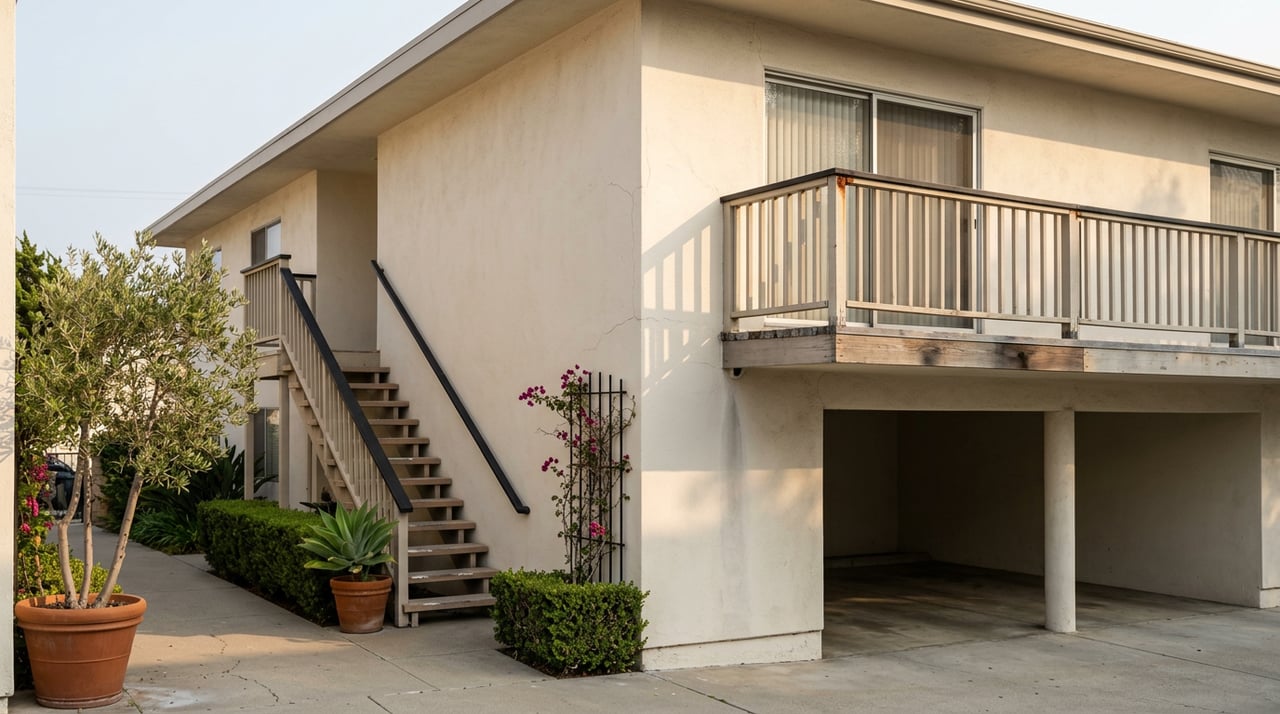
If you're shopping for a condo in Santa Monica right now, you've probably heard about SB 326, the state law that requires homeowners associations to inspect balconies, decks, and walkways for structural safety. It's become a standard line item in due diligence conversations across California, and for good reason: the first compliance deadline passed on January 1, 2025, and plenty of buildings still haven't caught up.
What most buyers don't know, because almost nothing written about SB 326 mentions it, is that Santa Monica has run its own, much older seismic retrofit program since 2017, and it applies to a different set of building types on a different set of deadlines with different qualified professionals. A building can be fully compliant on one and quietly behind on the other. I've started asking sellers' agents for both reports before I let a buyer client get attached to a unit, because "we passed our balcony inspection" and "this building is seismically compliant" are two completely separate claims, and confusing them is the most common mistake I see in Santa Monica condo escrows this year.
The Law Everyone's Heard Of
SB 326, codified as California Civil Code section 5551, requires condominium associations with three or more units to inspect exterior elevated elements, meaning balconies, decks, stairways, and walkways that sit more than six feet above ground and are supported substantially by wood. The law was written after a 2015 balcony collapse in Berkeley, and it requires a licensed structural engineer, architect, or (as of a 2024 amendment) civil engineer to complete the inspection. General contractors, even experienced ones, aren't qualified to sign off.
The first inspection deadline was January 1, 2025. Unlike the parallel law for rental apartment buildings, SB 721, which Bay Legal says had its deadline pushed a year to January 1, 2026, SB 326 has its own deadline. A separate 2025 law, SB 410, clarified that the inspection report has to be part of the reserve study disclosures given to buyers.
That part is well covered elsewhere. Here's what isn't.
The Ordinance Nobody Mentions in the Same Breath
According to Seismic Ordinances, Santa Monica passed its own comprehensive seismic retrofit program back in March 2017, years before SB 326 existed, and it covers a different problem entirely: not balconies, but whole-building structural vulnerability in earthquakes. The program identified roughly 2,000 buildings across the city that fall within its scope.
According to Retrofit1, soft-story deadlines have been running through the back half of 2025: buildings with more than two stories and fewer than 16 units were required to complete retrofit work by September 2025, buildings with 16 or more units by October 2025, and two-story buildings with 7 to 15 units by November 2025. Other buildings have deadlines that vary by notice group. The city's non-ductile concrete ordinance was amended again as recently as October 14, 2025, which tells you this isn't a program winding down. It's still actively enforced and still being adjusted.
There's also a live deadline worth flagging for anyone whose building is mid-retrofit: the city's seismic retrofit grant program, which reimburses part of eligible design and construction costs and is tied to FEMA approval, lists an application submission deadline of August 31, 2026, according to Prostruct Engineering. That's 11 days from now, which makes it one of the more time-sensitive dates in this whole picture.
Where the Two Clocks Diverge
Here's the scenario that catches buyers off guard. A three-story wood-frame condo building in Santa Monica finishes its soft-story seismic retrofit in late 2025, gets its certificate of completion from the city, and the listing agent proudly mentions "seismically retrofitted" in the marketing copy. A buyer hears that and assumes the building is fully covered on the safety-and-compliance front. But the seismic retrofit program has nothing to do with SB 326. That same building's balconies could still be sitting on an inspection that was due back in January 2025 and never happened, because the HOA board was focused on the seismic project and didn't realize the balcony law was a separate obligation on a separate clock, requiring a separate professional's signature.
The reverse happens too. A board completes its SB 326 balcony inspection on schedule, gets a clean report, and assumes the building is in good shape. Meanwhile the same building sits on the city's soft-story list with an order that's been sitting unaddressed, because nobody connected "we handled the balcony law" with "we still owe the city a structural evaluation under a completely different ordinance."
Neither board is being negligent. They're responding to whichever compliance letter landed in the mailbox first. But from a buyer's chair, "compliant" in Santa Monica is not one word. It's two separate document requests, two separate professionals, and two separate cost exposures that don't automatically move together.
Here's a quick side-by-side of how the three regimes actually differ:
| SB 326 (Civil Code §5551) | SB 721 | Santa Monica's Seismic Retrofit Ordinance | |
|---|---|---|---|
| Applies to | Condo HOAs, 3+ units | Rental apartment buildings, 3+ units | Buildings covered by the city ordinance |
| Covers | Balconies, decks, stairways, walkways over 6 feet, wood-supported | Same elements, rental context | Overall structural retrofit of the building |
| First deadline | January 1, 2025, passed | January 1, 2026, extended by AB 2579, also passed | Phased by building category, mostly September through November 2025 |
| Reinspection cycle | Every 9 years | Every 6 years | One-time completion and city sign-off, not a recurring cycle |
| Who can inspect | Licensed structural engineer, architect, or civil engineer | Structural engineer, architect, or qualified contractor | Licensed civil or structural engineer, or registered architect |
What This Costs When It Goes Wrong
The dollar figures on both sides of this are large enough to change a purchase decision. SB 326 inspections for a mid-size condominium complex typically run $15,000 to $50,000 or more, and that's before anything gets found. When balcony inspections do turn up dry rot or structural deficiency, per-balcony repair costs commonly land in the $10,000 to $25,000 range, and severe cases in older buildings have generated special assessments as high as $175,000 per unit. According to Apex Balcony, California law allows civil penalties of $1,000 to $5,000 per day for HOAs that remain out of compliance, which means a building sixty days overdue could be looking at cumulative exposure up to $300,000 before a single repair has even started.
On the seismic side, retrofit construction costs vary enormously depending on building type and size, but they're funded (or not) through the same reserve study that's supposed to be covering the balcony inspection obligation too. A board juggling both compliance regimes on a reserve study that was sized for routine maintenance, not two overlapping structural mandates, is exactly the kind of building where a buyer discovers a special assessment vote scheduled for the month after close.
The Financing Wrinkle
This is the part that turns a paperwork gap into a closing delay. Lenders financing condo purchases in this market have started asking for proof of SB 326 compliance before approving the loan. If a building can't produce the inspection report, or the report shows unresolved findings, the loan can be delayed or denied outright. That's a real risk to a purchase timeline that has nothing to do with the buyer's own creditworthiness and everything to do with whether the HOA board did its paperwork.
What To Ask For Before You Write an Offer
Before I let a buyer client submit an offer on a Santa Monica condo, I ask the listing agent or HOA management company for:
- The SB 326 exterior elevated element inspection report, including the date it was completed and who performed it
- Confirmation of whether the building appears on the city's seismic retrofit list, and if so, which category and what the compliance deadline is
- The certificate of completion for seismic retrofit work, if the building has finished it
- The current reserve study, and whether it has been updated to reflect either inspection's findings
- Any notice of a pending or proposed special assessment tied to either requirement
If the HOA can't produce all five documents cleanly, that's not automatically a reason to walk away, but it is a reason to build extra time into your inspection contingency and to have your lender confirm in writing that financing won't be held up by a missing SB 326 report.
A Few Direct Questions
Does a building being on Santa Monica's seismic retrofit list mean it's unsafe to buy? No. Being listed means the building has characteristics the city wants evaluated, not that it has failed an evaluation. Plenty of listed buildings are working through the process on schedule.
If my building already finished its seismic retrofit, do I still need to worry about SB 326? Yes. They're unrelated laws with unrelated timelines, and a completed seismic retrofit says nothing about whether the balcony inspection required under Civil Code 5551 has happened.
Can I ask to see the reserve study before making an offer? Yes, and under state disclosure requirements tied to SB 410, the SB 326 inspection findings are supposed to be part of that document. If the seller's HOA can't produce it, that delay tells you something too.
If you're weighing a Santa Monica condo and want a second set of eyes on what a specific building's HOA paperwork actually shows, I'm happy to help you read it before you write the offer, not after. Work With Kati
This article is general information, not legal, tax or financial advice. Consult a qualified professional about your situation.